lunes, 16 de marzo de 2020

Social Science 16th-29th March, 2020

Hi everybody!

Due to this extraordinary situation we are going to work from home these days.

Your task for Social Science for these two weeks is:

EU COUNTRY RESEARCH

You have to prepare a presentation (PowerPoint, Google slides...) about an EU country member. You can choose the country you prefer. In the presentation there must appear:

 - Name of the country, area in km2, capital, flag, map, where is it located.
 - Limits: north, south east and west
 - Number of inhabitants and population density.
 - Geographical characteristics: main mountains, seas, rivers, lakes...
 - Important cities (minimum two)
 - Main economic activity
 - Languages
 - Year of joining the EU
 - Main tourist attraction.
 -Curiosities, extra information...


The due date for sending this homework is March, the 29th. You can share it with us through Google drive o send it by e-mail.


6th A and 6th B: ipascual@educacion.navarra.es

6th C and 6th D: sruizmarti1@educacion.navarra.es

If you don’t have access to a computer you should do it in a cardboard and bring it to school the first day we come back.

This work is going to be evaluated as part of the subject so, try to do your best!

Best wishes! We hope to see you soon!!!

Iosune and Sandra

Martxoaren 16tik 20ra

Kaixo!
Classroom-en jarri dizuet lana Ametsetako etxea deskribatzeko. Euskara liburuan adibideak dituzue. Honetan bakarkako lana egin beharko duzue. Zalantzaren bat izanez gero email bat bidali. Ongi izan! Mila esker!


¡Hola!
Ya tenéis en Classroom la tarea de describir Nire ametsetako etxea. En el libro de euskara tenéis ejemplos. Esta vez será un trabajo individual. Si tenéis alguna duda enviarme un email. Eskerrik asko!


Hemen dituzue ere lotura batzuk filmak ikusteko:

Zentzu guztietan

Goazen!


domingo, 8 de marzo de 2020

SOCIAL SCIENCE EU exam

Hi everybody!

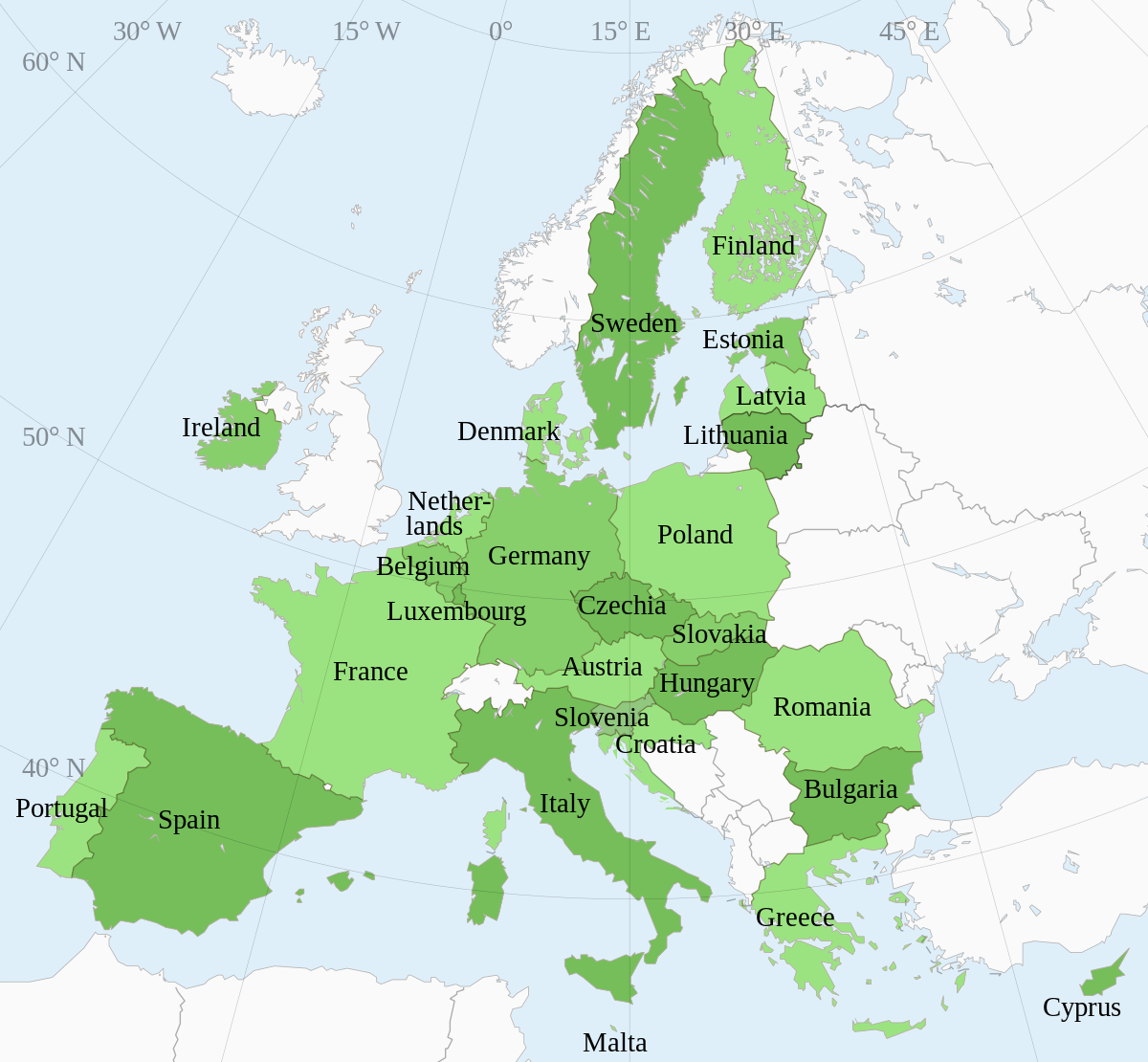
Here you have the map of the EU countries:

Resultado de imagen de european union countries

And these countries are divided into Euro area members and non-euro area members:

EURO AREA MEMBERS:

Austria , Belgium, Cyprus, Estonia, Finland, France, Germany, Greece, Ireland, Italy, Latvia, Lithuania, Luxembourg, Malta, The Netherlands, Portugal, Slovakia, Slovenia and Spain.

NON EURO AREA MEMBERS:

Bulgaria, Croatia, Czech Republic, Denmark, Hungary, Poland, Romania and Sweden

THE EUROPEAN UNION

The European Union is organised in a similar way to a country. Its aims are to protect and strengthen the rights and interests of its members.

History of the European Union

After World War II, many European countries wanted to create a political and economic union. In 1957, the Treaty of Rome created the European Economic Comunity (EEC). Belgium, the Netherlands, Luxembourg, France, Germany and Italy were its founding members. in the 1970's new members joined.

In 1992, 12 countries, including Spain, signed the Maastricht Treaty. The EEC became the European Union (EU) in 1993.

Objectives of the European Union


  • Promote freedom, security and prosperity to its members.
  • Respect cultural and linguistic diversity
  • Promote peace and democracy
  • Protect diplomacy and the rule of law.

The EU invests in education, medical, scientific and technological progress. Also the movement of people between member states.

The EU also has economic aims. It creates systems to permit goods, money and services to move freely between EU countries, and encourages the development of small businesses and innovation. The EU aims to create jobs and promote economic growth. However, if a member state has economic problems, the EU also requires other member states to work together to help them.

The institutions of the EU
The main EU institutions can be found in three European cities: Brussels, Strasbourg, and luxenbourg city.
  • Brussels
The European Council meets a minimum of four tiems a year to decide the priorities and the direction of the EU. It does not make or adopt laws, it has an exclusive role.

The European comission is the executive power of the EU. It cannot make laws, but it proposes laws. It decides the financial prioritiesof the EU.

The Council of the EU is a legislative institution. It debates and passes laws, and approves the EU budget. It is made up of 10 different councils, each one responsible for a different area of legislation.
  • Strasbourg
The European Parliament prepares legislation, passes laws and approves EU budgets. Members are elected directly by EU citizens. The number of MEPs per country is proportional to its population. It also has bases in Luxembourg and Brussels.
  • Luxembourg City
The Court of Justice is a judicial institution. There is one judge from each member state. The European Court fo Auditors is to make sure money is collected from EU tax payers and that the money is used correctly.


THE BENEFITS OF JOINING THE EU

Spain joined the EU in 1986. It has recived EU funding and support for many projects.

Doing Business

The Single Market means that buying and selling goods and services is governed by the same regulations. It started in 1993.

EU companies have to pay more tax to trade with non-EU countries. The Euro as a common currency was very important in developing a single market within the EU.

Work, study and travel

The right to freedom of movement allows Spanish citizens to work and travel in any EU country without a visa or special work permit. There are almost no border controls.

EU citizens have access to healthcare in other member countries. They can use the health system of that country for free. They have access to the same rights to healthcare as the citizens of that country.

Studying Abroad

Students who are citizens of the EU can attend school in any other EU country and are entitled to the same conditions as students who are citizens of that country. Children can have free language classes to help them adapt to the new school system

Research and innovation

Many Spanish researchers benefit from research grants to work and study in other EU countries. Research projects in Spain such as cancer research, climate change or ageing population.

The agriculture industry

The EU financially supports the agricultural industry in Spain. Half the money that Spain receives from the EU is for agriculture.

Buying quality products

Products that are made or sold in EU countries must comply with EU safety standards.  CE safety mark.

The environment

Many Eu regulations exist to help companies and governments improve the environment and control the way they manage waste. The EU also aims to protect national parks.

Infraestructure

The EU has invested in projects such as the extension od Fuerteventura's airport and high-speed railway linking Spain and France.

ECONOMIC SECTORS IN EUROPE

Primary sector

Europe has many different climates, and diverse landforms and relief. The primary sector in this area produces a wide variety of products.
Hillsides of the Scandinavian countries, Germany, northern France and Spain are ideal for forestry.

Areas of southern Europe are excellent for growing fruit and vegetables.

Four percent of the active population works in the primary sector.

Europe is the biggest exporter of wood worldwide. It exports raw materials such as mineral, metals, chemicals, fruits and vegetables.

There are now restrictions in place to make sure Europe does not lose too many trees.


  • ARABLE FARMING: France, Germany, Czech Republic, Ukraine... Mostly in Central Europe
  • LIVESTOCK FARMING: north Russia, Greece, Ireland, Spain, U.K....
  • FORESTRY: Finland, Sweden, Norway... Mostly in the North.
  • COAL: U.K., Poland, Germany, Ukraine...
  • FISHING: north and south Europe, coastal countries: Spain, the Hetherlands, Italy...
  • WOOD: Spain, Finland, Sweden, Poland...
  • IRON: Spain, France, Sweden, Ukraine...
  • URANIUM: France, Germany, Sweden...
  • OIL AND NATURAL GAS: North Sea


Secondary sector

Secondary sector industriestransform natural products into manufactured products. 22% of the European active population works in the secondary sector. Most people work in food-product manufacturing. Manufacturing of metal products, machinery and plastics is alsop very important. Spain and Germany produce more cars than the USA and Canada combined.

Tertiary sector

74% of the European population works in the tertiary sector. The most important industries are transport, tourism and trade.

  • Transport: Well developed road and rail network (Amsterdam, Brussels, Dublin and Barcelona). 5% of European active population works in transport. Air and sea transport: transporting goods makes large contribution to Europe's economy (Rotterdam, Antwerp and Hamburg are some of the largest ports in the world).

  • Tourism: Contributes greatly to Europe's economy. It's particularly important in Spain, France, Greece and Italy. On average 9% of the population are employed in tourism.

  • Trade: Europe imports more raw materials than it exports. It exports cars and other types of machinery to other continents.


ENGLISH UNIT 6 EXAM

As you know next week we are having a grammar and listening exam.
Here you have the contents you need to know:

VOCABULARY


GRAMMAR


martes, 4 de febrero de 2020

ENGLISH UNIT 5 EXAM

VOCABULARY

GRAMMAR

VOCABULARY 2


READING
WRITING


WRITING EXAMPLE

TITTLE: WATER-COWS!!!!

CAPTION: Hervasia and her best friend Figuerón


INTRO: Last weeek in the Atlantic Ocean, Hervasia and Figuerón, her best friend, surprised all the tripulation from Open Arms ship. They were doing a cool Titanic choreography in thge middle of the sea so the sailors were ashtonished.

DIRECT/REPORTED SPEECH: We spoke with Captain Hook: “ I was really surprised because I couldn’t believe my eyes”. His helper Smith told us he fainted when he saw that.

MORE DETAILS: They took amazing photographs and recorded some videos of the strange event and they have become viral so nowadays they are billionaire.

EXTRA INFO: If you want to see the photographs and watch the videos follow them on Twitter, Instagram and facebook or visit www.hervasiaandfigueron.com

BY 6ºD

TITTLE: GIGANT HERO!!!


CAPTION: Toast runing behind Pancho


INTRODUCTION LINE: Last week in Miami, Toast the gigant dog, saved Pancho (his owner) from the biggest tsunami known today. Scientists called the tsunami Sushi.

DIRECT SPEECH: “I was playing with Toast from my helicopter when suddenly Toast got really nervous so he started to bark” said Pancho. “when Toast barks it seems to be the end of the world!” he added.

REPORTED SPEECH: Pancho told us that it wasn’t the end of the world, it was a gigant tsunami so they started to run to save their lives. He said he climbed to Toast’s head and they run as fast as Toast could.


MORE DETAILS: The tsunami made a lot of damage in the city buildings but Pancho and Toast saved a lot of citizens. Toast used his gigant stick to block the water ans stopped the tsunami.


EXTENDED INFORMATION: For more information you can visit www.supertoasthero.com


SOCIAL SCIENCE BUSINESS EXAM


TYPES OF BUSINESS

A business is an organisation that offers goods or services to customers, categorized by economic sector, geographical area or size.

ECONOMIC SECTORS

Primary sector business produce or extract raw natural materials (mining, forestry, agriculture and fishing.

Secondary sector: business process raw materials or use them. This is often done in factories.

Tertiary sector: businesses that offer a service (hairdressing, food services, entertainment, tourism….)


SIZE

The size of the business depends on the number of employees:

  • Micro-business: 1-9 employees
  • Small business: 10-49 employees
  • Medium-sized business: 50- 249 employees
  • Large business: 250+ employees

GEOGRAPHICAL AREA


  • A local business operates in a small area (neighbourhood, town or city)
  • A regional business operates in a larger area (province, region)
  • National business does it in more tha one region of a country
  • Multinational business operates in more than one country or worldwide.


BUSINESS ORGANISATION

Business organise employees or staff into departments and levels: Organograms.

The Chief Executive Officer(CEO) makes the most important decisions.

The directors of the different depatments report to the CEO. In large business there are financial director, sales director…

Managers organise the daily activities of their departments and are responsible for the team.

Supervisors: report the managers.

Different departments:

  • Production department: responsible of how products are made
  • Marketing department: responsible for advertising
  • Sales: responsible for selling the services/products
  • Finance: controls the money
  • Human resources: hires and trains employees.
Small businesses do not usually have as many levels of organisation, only teams and supervisors, and the CEO is often the owner.


COSTS OF RUNNING A BUSINESS

People who start their own business are called entrepreneurs. Starting a business has start-up costs. Some entrepreneurs get a loan from a bank or a grant from the government.

The profit is the extra money that a business has after it has paid all its running costs (things paid day to day). They can be:

  • FIXED COSTS

They need to be paid on a regular basis. They include rent, salaries, utility services such as telephone or internet and insurance in case of accident.

  • VARIABLE COSTS

They depend on the products and services that a business wants to sell. They change over time.

Variable costs include the materials a business needs to make its products. Shipping costs cover the cost of delivering products to customers. Bonus (extra money) if they meet sales or production objectives. Promotional costs that depend on the type and amount of advertising.


SAVING AND SPENDING MONEY

The movement of money is calles cash flow. Money moves around when you earn it, spend it or put it into investments or a bank account. The bank uses the money or capital to do business and make a profit, you receive it as interest.


SAVING MONEY
  • Keep a money jar
    • Advantages: quick and easy and you do not pay fees.
    • Disadvantages: will not earn interest, money can get lost or stolen.
  • Opening a savings account
    • Advantages: money will be safe and earn some interest.
    • Disadvantages: low interest and fees.

SPEND LESS AND SAVE MORE


Shops often have special offers and sales when prices are reduced. If you look at prices in different shops and online, you can find bargains. However, you should think carefully before you buy and decide whether you really need the item.


  • Personal budgeting
    • you should keep a record of the money you receive, your income, and the money you spend, your expenses.